
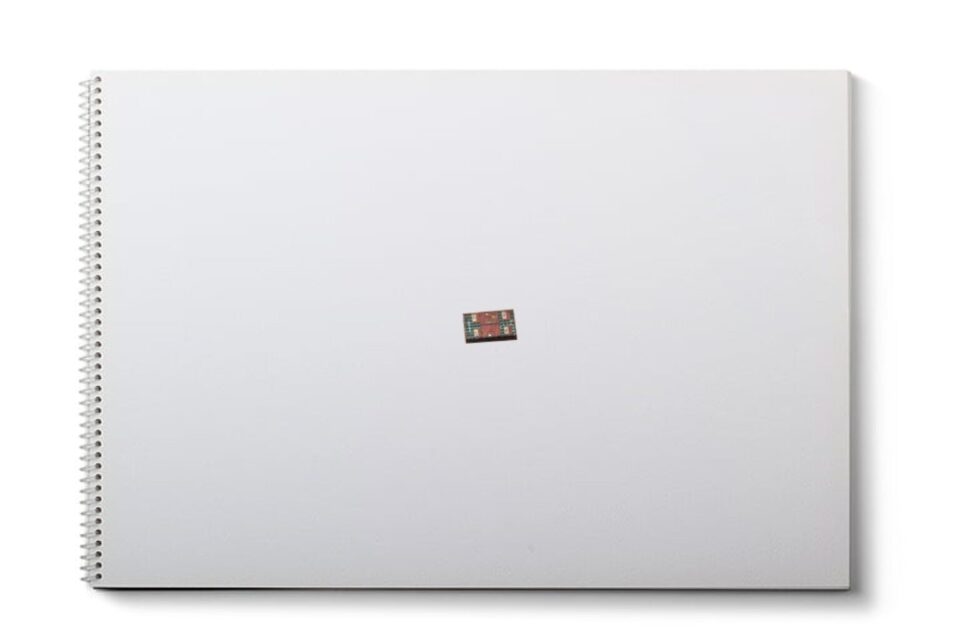
What if robots were so tiny that it would be impossible to see them with the naked eye—yet they were intelligent enough to sense their surroundings, make decisions, and carry out tasks independently? This amazing concept is now a real thing. The researchers from the University of Michigan and the University of Pennsylvania have created the smallest programmable robots in the world, thus, the evolution of robotics and micro-technology has a new chapter.
Tiny Robots With Big Capabilities
Each robot is less than a single grain of sand, the sizes of which are only 0.2 by 0.3 millimeters. In fact, these robots have all the essential parts of a working unit: a processor, sensors, a power system, and communication capabilities, despite their almost non-existent size.
In contrast to conventional robots which use heavy batteries, these micro-robots derive their power from light. Small solar cells integrated into their frame obtain energy from the light sources outside, hence no need for wires or battery replacement is there. This revolutionary device makes them extremely energy-saving and thus the perfect choice for situations where the battery cannot be replaced or recharged.
How Do These Robots Move?
Movement at the microscopic scale is much more complex than one would assume. At that level, water is more similar to a thick syrup than a normally flowing liquid. Usual motors, wheels, or propellers cannot be used.
Scientists came up with a clever fix for this issue called electrokinetic propulsion. The robot does not push against the water, instead, it generates an electric field that moves charged particles in the vicinity of the liquid. These particles take hold of the liquid in which they are immersed and thus, they are able to drag the fluid along, which results in the robot being pushed forward.
What’s the outcome? The robots achieve smooth, controlled movement without any moving mechanical parts. Thus, they become more durable and can be used in the long-term in desensitized areas.
Built to Sense, Think, and Act
What, in fact, sets these robots apart is their smartiness. A mini-computer is there in each robot to receive the information through the sensors and perform accordingly. So, in simple terms, robots can sense the changes in the temperature and can even regulate their actions by the information they gather.
Usually, an increase in temperature is a sure sign of intensification of biological or chemical processes. In this way, the robots become perfect first signal devices for the presence of small changes in the environment, which is a huge boon for science and medicine, by detecting these slight variations.
Additionally, they are extremely low energy consumers, which is quite astounding to be true. The local computer is working on nanowatts of energy, thus, it is very little energy to that of a normal wearable gadget is being used. This accomplishment is a clear demonstration that a huge piece of hardware is not always required for advanced computing.
Why This Breakthrough Matters
The innovation of the tiniest programmable robots in the world is not only about minimizing tech but also about maximising the potentials of these robots. In fact, these robots might revolutionize different industries very soon.
1. Medical and Healthcare Applications
In medicine, these robots could be employed to constantly monitor cellular activities, recognize abnormalities, or deliver targeted treatments. By their very nature, they might be able to navigate in parts of the human body which are currently inaccessible by conventional tools, hence, providing not only accurate but also more detailed diagnostics and therapies.
2. Scientific Research
Microscopic robots are capable of exploring extremely small environments such as microfluidic systems or chemical samples. They could be the ones to fully automate laboratory experiments, be at the forefront of experiments and collect data that they could use to give you an insight that you could never imagine before.
3. Advanced Manufacturing
In manufacturing, these robots might be the ones to help in the assembly or inspection of the tiniest parts that are the core of the technologies such as electronics, semiconductors, and precision devices. Since they can operate in areas that are tightly confined, they are the perfect tool for future production processes.
The Power of Swarm Intelligence
Each robot having a different personality is another thrilling aspect of the story, which enables scientists to implement different behavior patterns for separate groups of robots. As a matter of fact, these micro-robot swarms may be able to do so one day—just like ants or bees—that is, they can divide a complex task among themselves and carry it out in a much more efficient way than one single robot.
The idea of swarm robotics is capable of bringing about a number of advantages, such as rapid data collection, enhanced problem-solving, as well as being more intelligent in automation and thus, having a great impact on the whole machine industry.
A Small Step That Signals a Big Future
The development of the tiniest programmable robots in the world is not just a scientific milestone—it is a vision of how intelligent machines will look in the future. As scientists keep on enhancing their speed, sensing capabilities, and ruggedness, these minuscule robots can be expected to make a significant healthcare, research, and advanced manufacturing industry.
Fast to recall science fiction, these breakthroughs are turning into reality—thus, small innovations have the power to change the world vastly.
